|
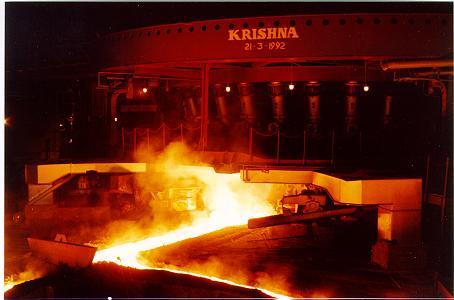
Iron is produced in the Blast Furnace by smelting iron bearing materials with
the help of coke and air. The solid charge materials like sinter, sized iron
ore, coke etc. are charged in the vertical shaft of the Blast Furnace from
top and hot air blast is blown through tuyeres located at the bottom.
The oxygen present in hot air combines with the carbon of coke and generates
heat and carbon monoxide (reducing agent). The reducing gases, while ascending
upwards comes into contact with the descending charge materials.
Eventually the charge gets reduced and hot metal, slag and BF gas are produced.
Hot metal and slag is tapped from tap hole. The Blast Furnace gas which comes out from top
of the furnace is cleaned and used as fuel in the plant.
|
-
Three Blast Furnaces of 3800 m3 useful volume each.
BF-1 & 2
-
New generation Paul-Wurth "Bell-Less" Top with conveyor charging
-
BF Cooling elements (Cast Iron Staves & Copper Staves)
-
High heat zone copper staves.
-
Double compensator tuyeres, with PCI injection facility and extended tuyere platform.
-
Circular type flat cast house with full castable runner system
-
Hydraulic Drilling Machine, Mud Gun, Manipulators.
-
Silencer to bin pressure relief.
-
New scrubber with annular gap element for better gas cleaning.
-
HMI based control room.
-
Equipped with above burden temperature Probes.
-
Automation with PLC in BF-1 and PCS in BF-2.
-
Pulverized Coal Injection system
BF-3
-
New Generation Parallel Hopper Bell Less Top
-
BF Cooling elements (Cast Iron Staves & Copper Staves)
-
Flat Cast house Equipment (by TMT).
-
INBA Slag Granulation system
-
Annular Gap Scrubber
-
Pulverized Coal Injection system
-
Hot Stoves (internal combustion chamber)
-
Automation with DCS
-
Production Capacity - 7.5 MT per Annum for shop
- 2.5 MT per Annum for BF-1, 2 & 3 each
-
Furnace - 1- 1st campaign since 28.03.1990 / 2nd campaign since 30.07.2014
-
Furnace - 2- 1st campaign since 21.03.1992 / 2nd campaign since 21.10.2017
-
Furnace - 3- 1st campaign since 24.04.2012
|
|